
AI service
AI integrated into the workflow your team already uses
Drafts, classification and in-app assistants that act on your real data, under your permissions, with a human review step where the stakes are high.
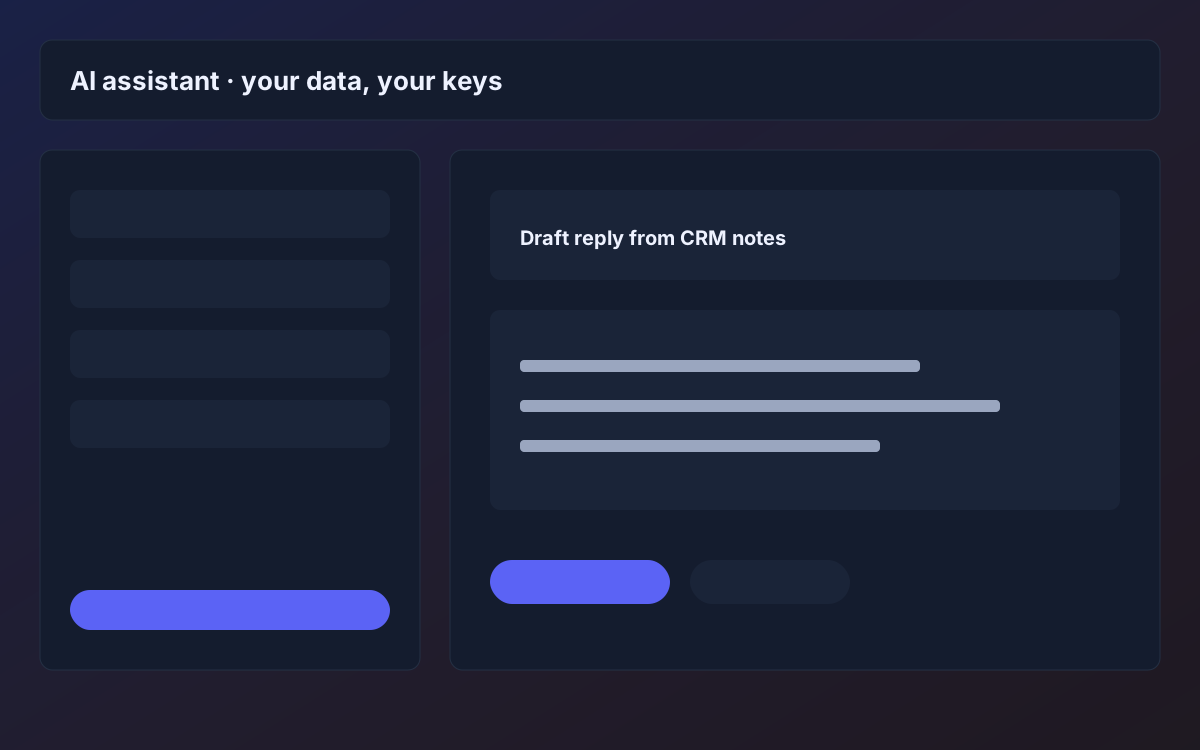
Most disappointing AI projects share a shape: a chat window beside the product that knows nothing about the product. Staff try it twice, get generic answers and go back to their old way of working. Useful AI sits inside the workflow. It reads the record in front of the user, proposes the next action and writes the result back to the system where the work lives.
We integrate language models into existing products and operations with that in mind. That means defining which tools the model may call, which roles may trigger them, what gets logged and where a person approves before anything irreversible happens. The model is one component. The permissions, review queue, logging and cost controls around it are what make it safe to rely on.
We work with OpenAI and Anthropic models, and with your own API keys. You choose the provider, you hold the account and you can switch later because the integration is built behind a clear interface. We scope one or two concrete workflows first, prove them with your real data and then widen the surface.
The problems
What usually goes wrong
An assistant that knows nothing about your data
A generic chatbot cannot see your customers, orders or documents, so answers stay shallow and users stop trusting it.
Pilots that never reach production
A demo impresses in a meeting, then stalls on permissions, logging, cost and reliability questions nobody planned for.
No control over what the model can do
Giving a model broad access to internal systems without roles, limits or approvals is a security and reputation risk.
Costs and quality you cannot see
Without logging, evaluation and spending limits, you cannot tell whether the feature is helping, drifting or quietly expensive.
What you get
Deliverables
Workflow and use-case scope
One or two specific workflows defined end to end, with the inputs, outputs, users and success criteria written down.
Model integration layer
A clean interface to your chosen provider, with prompts, tool definitions and retries kept in code you control.
Permissioned tool access
The model can only read or change what the signed-in user is allowed to, enforced on every call, not just in the prompt.
Review queue and approvals
A place where suggested drafts and actions wait for a person, with edit, approve and reject paths and a record of the decision.
Logging, evaluation and cost limits
Traceable inputs and outputs, a set of test cases for quality, and rate and spending guardrails with rough cost notes.
Handover documentation
Prompt and tool inventory, data-flow notes, runbook for provider outages and guidance for changing models later.
How it works
Step by step
01
Pick the workflow
We select a concrete task with clear inputs and a reviewable output, and agree what good looks like in terms your team recognizes.
02
Map data and risks
We document what data the model sees, where it goes, who can trigger it and what could go wrong, then set the review rules.
03
Prototype on real examples
We build a working version and test it on your actual records, adjusting prompts and tools based on where it fails.
04
Integrate and harden
We connect it to your product with permissions, review queue, logging and limits, and demo it weekly to the people who will use it.
05
Launch to a pilot group
A small team uses it first. We watch results, tune behavior and widen access once the review data looks healthy.
Timeline
How long it typically takes
A single well-bounded workflow, such as drafting replies or classifying incoming items inside an existing product, often takes three to six weeks from approved scope. Broader assistants with several tools and approval paths typically take two to four months. Data access and review rules usually need more time than the model work itself.
Who it's for
- Product teams adding assistants or drafting features to an app that already has users
- Operations teams with a repetitive text-heavy task and a person who can review the output
- Companies that want AI under their own keys and permissions, not a shared third-party account
Who it's not for
- Teams hoping AI will fully replace a skilled decision with no review path
- Projects with no existing data or workflow for the model to work with
- Use cases where an error would cause serious harm and nobody can review it
Honest scoping
Where AI helps, and where it doesn't
Where AI helps
- Drafting replies, summaries and notes that a person reviews before sending
- Classifying and routing tickets, emails and forms into the right queue
- Extracting structured fields from text-heavy records
- Answering staff questions against your own documents with sources shown
Where it doesn't
- Decisions that need accountable judgment and cannot be reviewed afterward
- Tasks that already work well as a simple rule or a database query
- Situations with no usable data or no way to check the output
- Anything where an occasional wrong answer would be unacceptable without a human in the loop
Data privacy
Your data stays yours
Bring your own keys. You hold the OpenAI or Anthropic account, and we store credentials encrypted when the product must keep them. We do not train models on your data through our application layer. Your provider's own data-handling terms still apply, and we help you choose settings such as retention options where they are offered. Prompts and logs live in your environment, and you control what is stored and for how long.
How we handle security →Keep exploring
Related pages
FAQ
Frequently asked questions
Which models and providers do you work with?
Mainly OpenAI and Anthropic models. The integration sits behind a clear interface so you can change providers or models later without rebuilding the feature.
How do you stop the model from making things up?
We cannot eliminate it, so we design around it. We ground answers in your records, require citations where possible, test against known cases and route risky outputs to a human before they reach a customer.
Will it work with our existing software?
Usually, yes. We integrate through your APIs, database or webhooks. We review the system during scoping and tell you what must change to make a safe integration possible.
How do you handle costs?
We set rate and spending limits, log usage per feature and give you rough cost notes so finance is not surprised. Because you hold the API account, billing is directly visible to you.
Can we start small?
We recommend it. One workflow with a review step, proven on real data, teaches more than a broad program and gives you a basis for deciding where to expand.
Next step
Tell us what you want to build
A short call, then a written scope in plain language before any build starts.
- Fixed scope
- Weekly demos
- You own the code