
Service
Software discovery that ends in a scope you can build against
A short, fixed engagement that turns a fuzzy goal into a written scope, a risk list and a price path. Take it into a build with us or hand it to another vendor.
Many software budgets are spent in the gap between what people think they agreed and what they actually need. Discovery closes that gap before the expensive phase begins. In a bounded engagement we talk to the people involved, map how work happens today and turn the answers into a document that someone could genuinely build from.
The output is concrete. You receive a process and systems map, a list of risks and open questions, a scope with milestones and non-goals, and estimate options for the build that follows. The risks section matters as much as the scope: integrations that may not be possible, data that is messier than assumed, decisions that belong to someone who has not yet been asked.
Discovery is priced and timed, not an open-ended consulting meter. The scope is yours whatever you decide next. You can build with us, ask other vendors to bid against the same document or conclude that the project should not go ahead, which is a perfectly good outcome if it saves you from a bad investment.
The problems
What usually goes wrong
Goals without a shape
Everyone agrees something should exist, but the picture differs between stakeholders. Quotes based on that fog vary wildly.
Quotes you cannot compare
Vendors respond to a vague brief with different assumptions and prices. You cannot tell which proposal is cheaper or just narrower.
Risks that surface mid-build
A missing API, messy data or an unconvinced department appears after the budget is committed. Each one becomes a change request.
Internal alignment that never happens
Sales, operations and finance each assume the system will solve their problem. Without a shared document, disagreements emerge at demo time.
What you get
Deliverables
Stakeholder interview summary
What each group needs, what frustrates them and where their priorities collide, written up without politics.
Process and systems map
How work flows today across people, spreadsheets and software, including the unofficial steps nobody had documented.
Risk and dependency register
Integrations, data quality, approvals, compliance questions and open decisions, each with an owner and a suggested resolution.
Written scope
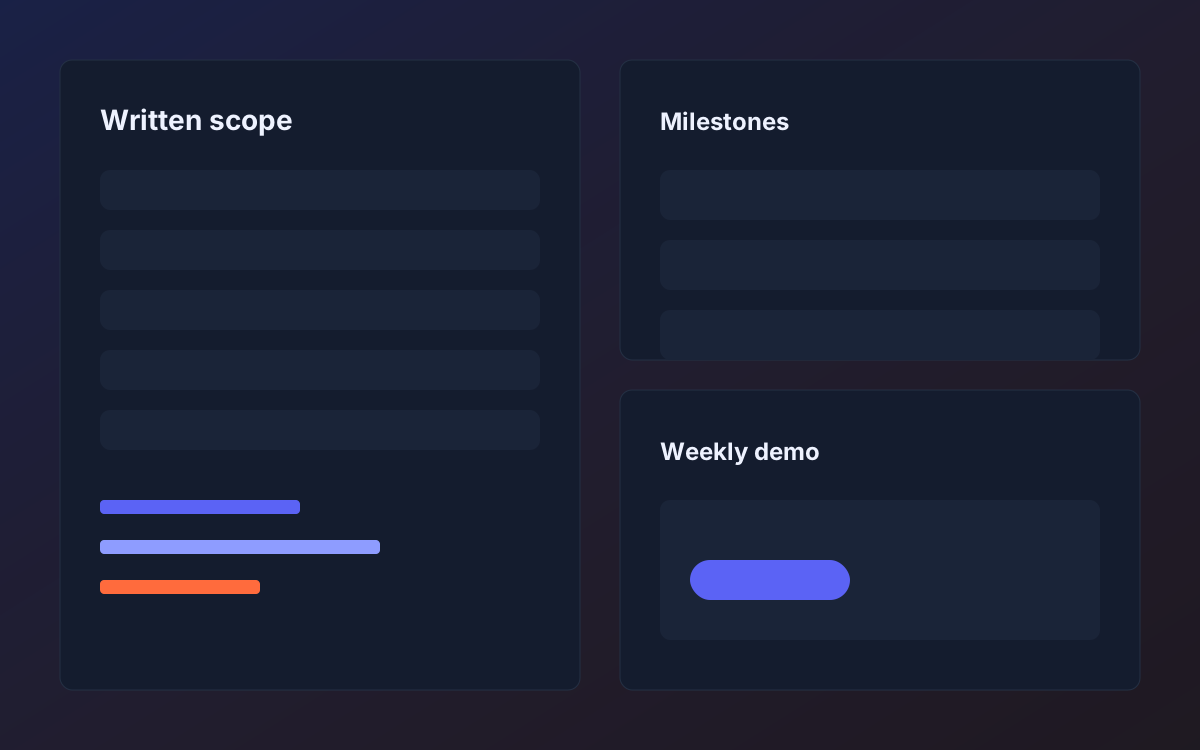
Users, features, rules, milestones, assumptions and non-goals in a format any competent team can estimate from.
Build estimate options
A fixed-price proposal or a capacity-based option, plus a staged route if you want to start smaller.
Go or no-go recommendation
A candid view on whether to proceed, change direction or wait, with the reasoning behind it.
How it works
Step by step
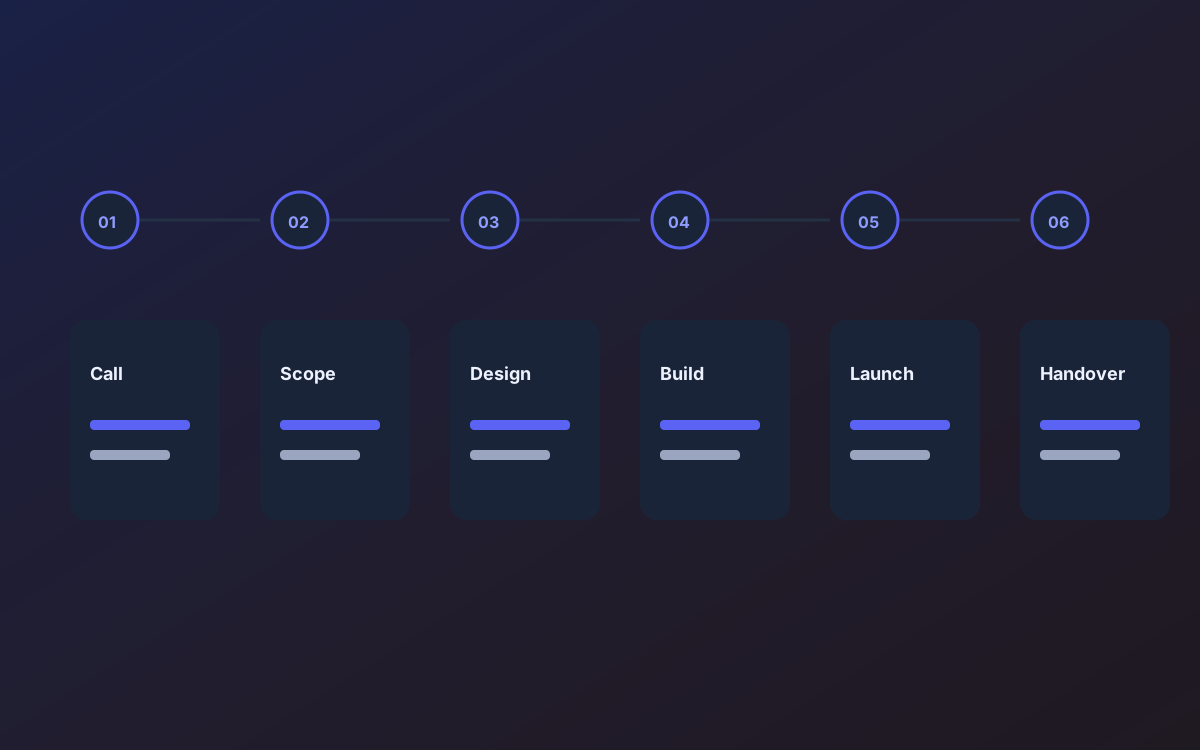
01
Kickoff and goals
We confirm what decision this discovery supports, who needs to be involved and what materials already exist.
02
Interviews and observation
We speak with the people who use, run and pay for the current process, and watch real work where we can.
03
Mapping and risk analysis
We draw the current process, identify what a new system must change and list what could derail it.
04
Draft scope and review
We write the scope and walk through it with your stakeholders, adjusting wording and priorities until the right people agree.
05
Estimates and decision
We present the build options and a recommendation. You decide what to do next with the document in hand.
06
Hand over and follow up
We deliver the full document set and stay available for questions while you review internally or brief other vendors, so the scope survives contact with your stakeholders and finance team.
Timeline
How long it typically takes
Discovery typically runs one to three weeks depending on how many stakeholders and systems are involved, with the scope document arriving at the end. Scheduling interviews is the most common cause of delay. The fee and timeframe are agreed before we begin, so there is no open-ended meter. A free introductory call comes first.
Who it's for
- Buyers who need a scope before committing a build budget
- Teams collecting competing bids who want one document to compare them against
- Projects that stalled and need assumptions reset before restarting
Who it's not for
- Teams with a complete specification and a ready design who just need delivery
- Buyers who want to start writing code this week with no planning
- Organizations without access to the people who know the current process
Keep exploring
Related pages
FAQ
Frequently asked questions
Is discovery free?
The introductory call is free. A full discovery that produces a written scope is a short, fixed-price engagement with the fee confirmed before it starts.
Do we have to build with you afterwards?
No. The scope belongs to you. Many clients continue with us because there is no re-discovery cost, but you are free to share the document with any other vendor.
Does the fee count toward the build?
That depends on the proposal. Where it does, we state the credit clearly in the discovery agreement rather than leaving it to goodwill.
Who needs to be involved from our side?
A decision-maker, one or two people who run the current process day to day and anyone who owns systems we may need to connect. We keep time demands tight.
What if discovery says the project is a bad idea?
Then it did its job. A clear no-go, or a smaller first step, is far cheaper to discover now than halfway through a build.
How detailed is the final scope?
Detailed enough that a competent team can estimate and start without repeating discovery: users, flows, rules, integrations, milestones and exclusions. It is not a pixel-perfect design, which comes later.
Next step
Tell us what you want to build
A short call, then a written scope in plain language before any build starts.
- Fixed scope
- Weekly demos
- You own the code